

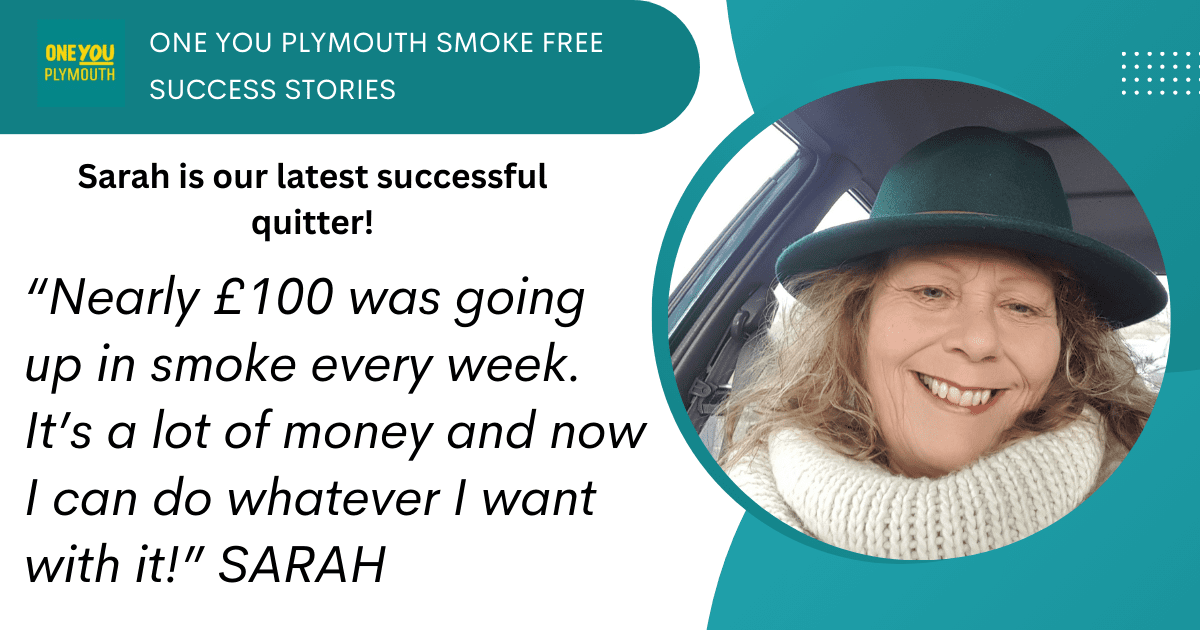
Sarah, 60, started smoking when she was 15 years old. When Sarah was 32, she successfully became smoke free as her husband did not smoke and they needed the money for their new house. Sarah remained smoke free for 5 years until her marriage ended and she found herself smoking 20 cigarettes a day again.
Many years later, a major health event brought about a significant turning point in her life, Sarah said: “I developed a bit of a cough but being asthmatic, I didn’t think much of it. I then got a pain killer stuck in my oesophagus and I started getting concerned so I went to see my doctor. It turned out to be oesophageal cancer.”
Subsequently, Sarah had to go through chemotherapy. Knowing that smoking significantly reduces the effectiveness of the treatment, she knew she had to quit.
She contacted her surgery for help, and they gave Sarah our contact details. After calling our friendly wellbeing team, she was put into contact with Lynne, one of our expert health improvement practitioners.
Lynne provided Sarah with specialised, one-to-one ongoing support, offering encouragement and understanding of the nicotine addiction process. Together they developed a personalised quit plan that included a quit date, strategies to cope with cravings, withdrawal symptoms, how to manage triggers, and more.
To further assist Sarah with her quit attempt, Lynne talked through all the stop smoking medications available. Out of all the options she decided to quit smoking with the aid of Varenicline (Champix), a stop smoking treatment that decreases the pleasure derived from smoking and helps reduce nicotine cravings and withdrawal symptoms, combined with nicotine patches, Sarah said: “I had my last cigarette on day 13 of taking the Champix. I put my ashtray and smoking materials in the bin and have never looked back. The whole process has been easy. I can honestly say that I have not had any withdrawal symptoms, no cravings, none of the irritability or weight gain at all. I have friends who smoke and it doesn’t even bother me. The whole process has been easy. I am convinced that it’s the combination of using patches and Champix together that’s made it so easy.
Thinking about how you’re going to cope without cigarettes is actually worse than what it’s like in reality. I’m so confident that I don’t need nicotine anymore, I’m reducing the strength of the patches. I’m undergoing the worse stress I’ve ever experienced with my diagnosis, but it hasn’t pushed me to buy a packet of cigarettes. You have to have a bit of willpower as you need to make that decision to stop, but the thinking is harder than the doing.”
Shortly after becoming smoke free, Sarah started to experience significant health benefits, saying: “My cough has gone and I haven’t used my inhalers at all since quitting. My breathing feels a lot easier and I’ve got so much more energy. My fingers and hands aren’t stained anymore and my skin looks better.”
There was one side effect of quitting that did sneak up on her: realising how unpleasant it was to smell smoke on others and regretting that non-smokers had to put up with the smell of her own smoking in the past, saying: “I remember sitting in a waiting room and a smoker sat next to me and it’s the first time I truly noticed how bad a smoker smells. It’s a stale odour! I suddenly realised that I used to smell like that and it’s not very nice for people who do not smoke. It shows how quickly you pick up on the negative aspects of smoking…the cough, the smell, inconveniencing yourself to go outside for cigarette breaks, and the money!”
Sarah’s 20 a day habit was costing her nearly £100 a week. Sarah said: “Nearly £100 was going up in smoke every week. It’s a lot of money and now I can do whatever I want with it. If I want some clothes or a new bit of kit for the kitchen or something nice for the house, I can afford to buy it. There’s so much you can spend £100 on, that’s a massive difference.”
In a final statement, Sarah expressed how much she valued having a health improvement practitioner by her side, saying: “Lynne was great. If I had any concerns, I can bring them up with her. She encourages me and reassures me that I’m doing all the right things.”